14 Oct ISAM 200: Metadata Collages — Revealing 200 Years of Museum Knowledge

In 2025, Iziko South African Museums (ISAM) mark two hundred years since the founding of the South African National Museum. This milestone not only celebrates the endurance of one of the country’s oldest cultural institutions, but also invites a critical reflection on what it means to preserve, interpret, and reimagine two centuries of collected knowledge.
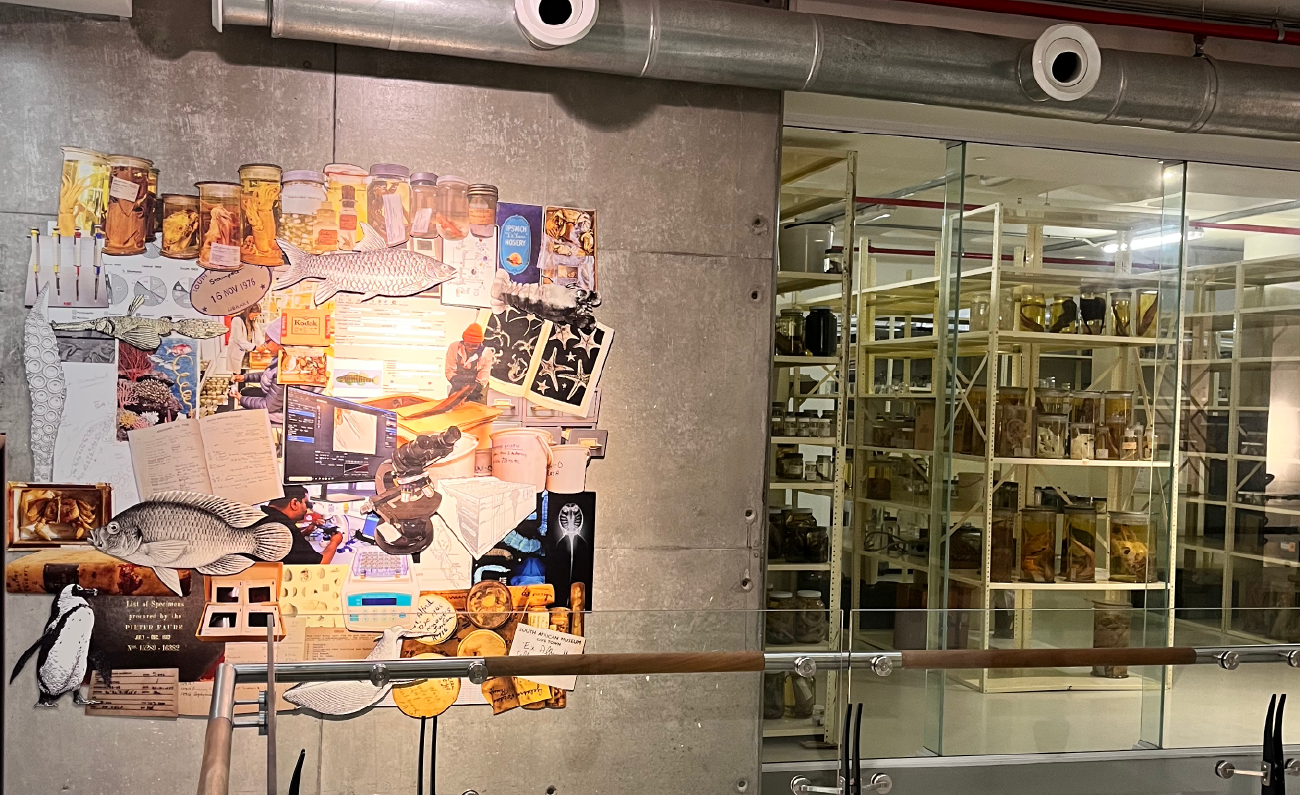
For this significant occasion, Studio Form was commissioned to design, build, and install a series of eight large-scale collages titled Metadata-Evolution, which explore how knowledge within museums is never static, but constantly rewritten. The project forms part of ISAM’s bicentennial commemorations, a moment that acknowledges both the depth of the collection and the unseen processes that shape it.
Unveiling the Invisible 99%
Most museum visitors only ever encounter a fraction—often less than one percent—of a museum’s holdings. The rest remain in archives, storerooms, and databases, hidden from public view. Metadata-Evolution brings that unseen layer to light. By tracing how curators, scientists, and archivists have documented, edited, and reinterpreted their collections over the past two centuries, the collages give visual form to the living system of “metadata”—the data that describes, organizes, and reshapes what museums know about their objects.
The result is a rare opportunity to peer behind the scenes of museum knowledge: the handwritten field notes, taxonomic revisions, curatorial annotations, and exhibition strategies that together shape what we come to understand as history.
Designing Change: Studio Form’s Approach
Studio Form approached the project through the principle of juxtaposition of change, weaving archival documents, field sketches, fossil imagery, and contemporary research photographs into layered visual narratives. Rather than presenting a simple “before and after,” each collage captures a continuum of change—the small edits and interpretive shifts that reveal how knowledge evolves across time.
Each of the eight collages corresponds to a different museum collection—Cenozoic, Archaeology, Geology, Entomology, Marine Biology, Exhibitions, Terrestrial Vertebrates, and the Karoo—and draws directly from its specific material culture. The Archaeology collage, for instance, is dense with excavation notes and stratigraphic sketches; Marine Biology carries traces of specimen photography and reclassification charts; while the Terrestrial Vertebrates piece references fossil reconstructions and early taxonomic drawings.
Through this approach, Studio Form transformed archival and scientific material into immersive, interpretive artworks that condense the complexity of each discipline into a single, richly layered composition.

Minimal Reinterpretation, Maximum Discovery
One of the guiding principles in the design process was “minimal reinterpretation.” The collages avoid imposing new narratives onto archival materials. Instead, they reveal the textures of metadata itself—the handwritten edits, overlays, and cross-outs that mark the evolution of museum thought.
Playful visual layering allows fragments from different time periods to interact: sketches float above photographs, curatorial notes overlap with digital records, and colonial-era imagery is acknowledged but placed within a larger, evolving narrative of reinterpretation. The result invites visitors to look closer, to read between fragments, and to sense the living motion of museum knowledge.
A Living Archive for a 200-Year Legacy
The Metadata-Evolution collages are more than artworks—they are interpretive tools that reframe how audiences engage with museum archives. They demonstrate that the work of the museum is not simply to preserve the past, but to continuously recontextualize it.
In celebrating 200 years of the South African National Museum, the project underscores the critical role of museums as dynamic, reflective institutions. Just as collections evolve, so too must the frameworks that interpret them.
By making visible the shifting language of metadata, Studio Form’s installation bridges the gap between collection and audience—between what is preserved, what is displayed, and what remains to be discovered.
Project Credits
Project Title: ISAM 200: Metadata Collages
Client: Iziko South African National Museum
Location: Cape Town
Timeline: April–October 2025
Type: Exhibition installation, Exhibition Design, Art Installation
Studio Form Roles: Design, production management, project management
Core Services: Concept design, technical drawings, fabrication oversight, installation, budgeting, stakeholder coordination